Autonomous drone surveillance in Belgium: 24/7 patrols over your site, operated for you
Autonomous drone surveillance rests on three building blocks: a docking station installed on your site, a drone that takes off, patrols and recharges on its own, and remote supervision. The system runs automated patrols around the clock and verifies an alarm within minutes, with no pilot on site. In Belgium, PIM Consult installs these systems and operates them for you.
You manage a large site, a depot, a sensitive facility. The dilemma is a familiar one: permanent guarding is expensive, fixed cameras raise false alarms that nobody goes out to check, and building your own drone unit, with hardware, remote pilots and authorisations, is not your business. Our Dock-as-a-Service model answers exactly that: we supply the dock, we obtain the flight authorisations and we supervise operations; you get the intrusion detection, the images and the reports. This page sets out how it works in three steps, which sites it suits, the choice between buying and subscribing, the Belgian regulatory framework and where your data is held. It sits within our full range of drone services for business and the public sector.
These are not brochure promises. Infrabel, Elia, the Walloon Public Service, the Belgian Federal Police and more than 20 police and emergency zones work with our teams. At PIM, Stéphane Tilmant runs the SORA and BVLOS files; Vincent François is DJI Dock 3 Advanced certified.
How autonomous drone surveillance works
An autonomous patrol always follows the same cycle: trigger, flight with alarm verification, return to the dock. Nobody sets foot on site; a supervising remote pilot keeps control remotely and can take over at any moment.
- Trigger. A perimeter alarm, a schedule of automated patrols or an ad-hoc request from your security control room launches the mission. The dock opens and the drone is airborne towards the area of interest in under a minute.
- Autonomous flight and alarm verification. The drone follows a pre-approved route, points its thermal and zoom sensors at the alert location and streams live video to your security team and to our supervision desk. Genuine intrusion or a fox on the fence line: you know within minutes, without sending a guard out into the dark.
- Return, recharge, report. Mission over, the drone lands in its docking station, recharges and goes back on standby. Every flight produces a time-stamped recording and a report your team can consult.
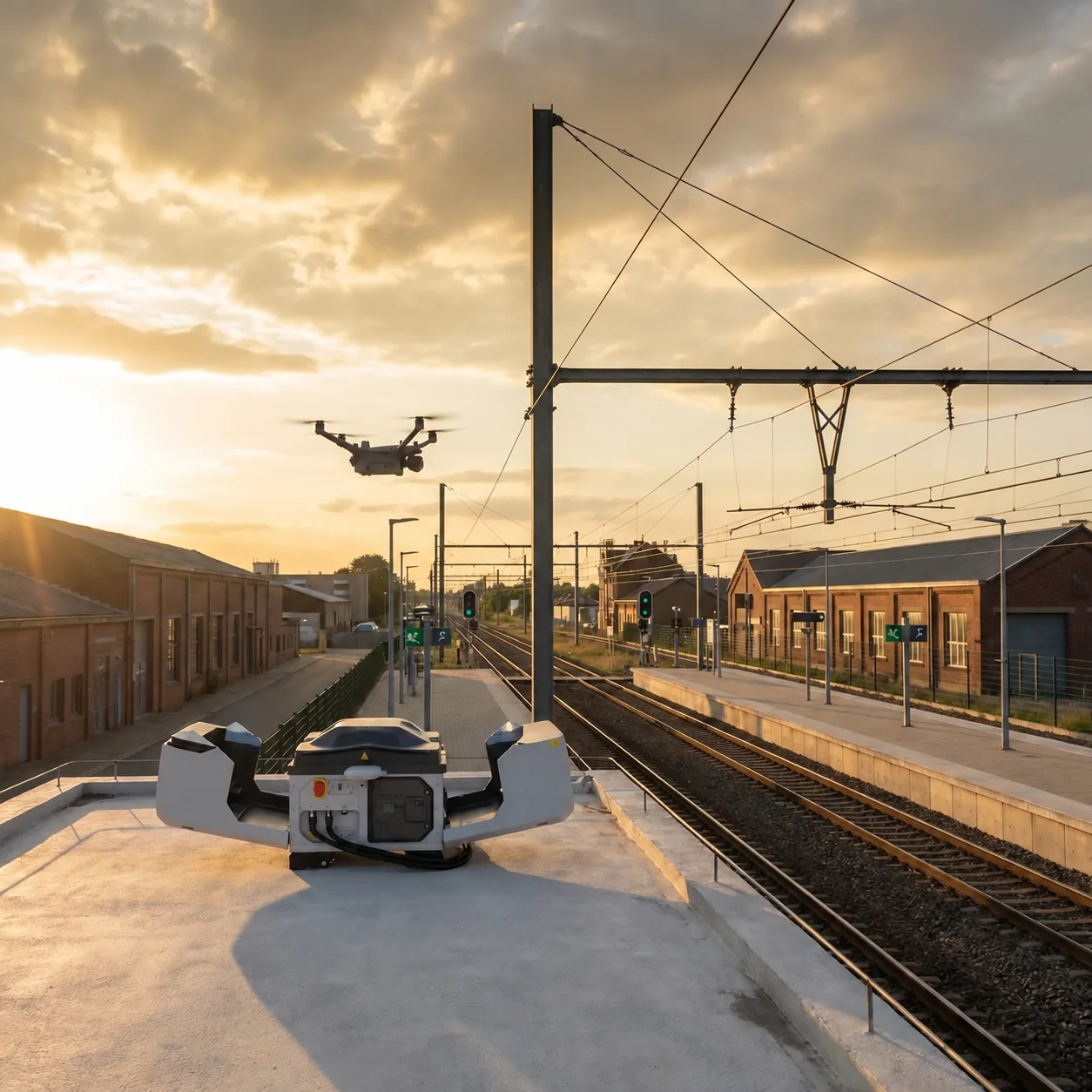
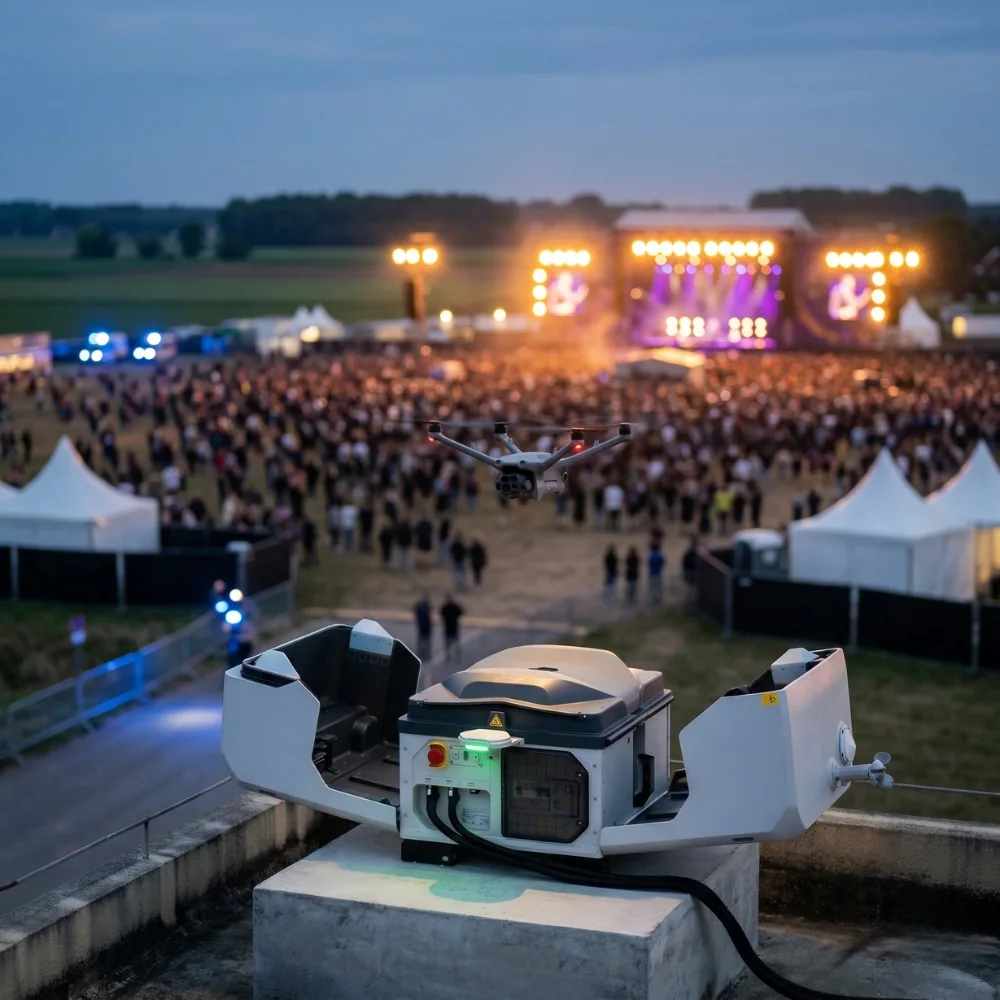
The equipment we operate: DJI Dock 3, Matrice 4TD and FlightHub 2
Three parts, one system. The DJI Dock 3 is the outdoor station that shelters, recharges and launches the drone in all weathers. The Matrice 4TD is the aircraft itself: thermal camera and a powerful zoom, built for intrusion detection by night as well as by day. FlightHub 2 is the platform that schedules the patrols, carries the live feed and archives the flights. For technical specifications and hardware prices, see Drone Parts Center, our group’s shop (link in the comparison below).
Use cases: which sites to cover with an autonomous drone in Belgium
An autonomous drone earns its place wherever size, darkness or risk make human surveillance incomplete: industrial sites, construction sites, linear infrastructure, emergency response areas. Four situations come up again and again with our Belgian clients.
Industrial and Seveso sites. Perimeters of several hectares, security obligations, recurring metal theft. Typical mission: thermal night patrols and verification of every perimeter alarm. Deliverable: a live feed to your gatehouse and an incident report.
Construction sites, logistics areas and ports. Materials and plant that disappear over the weekend, port areas that cannot realistically be fenced. Typical mission: patrols scheduled outside working hours, with time-stamped images that stand up if a complaint is filed.
Critical infrastructure: rail and energy. Linear corridors tens of kilometres long, and acts of sabotage that cost hours of operation. Typical mission: patrols over sensitive sections and rapid verification after an alarm. This is the ground we know best: our teams already work for the national rail and electricity network operators.
Police and emergency zones (DFR). The drone as first responder takes off the moment the call comes in and relays the situation before the first patrol arrives. Belgian organisations are equipping themselves: since 2025, autonomous drone surveillance has even been trialled around prisons, starting with Haren.
Buy a dock, or subscribe to the operated service?
The real question is not the hardware but who operates it: a dock with no remote pilots, no authorisations and no maintenance watches nothing. Here is how the two models compare.
| Criterion | Buying a dock | PIM Dock-as-a-Service |
|---|---|---|
| Investment | Hardware purchase (CAPEX), through Drone Parts Center | Monthly subscription, no capital tied up |
| SORA and CAA authorisations | To be built in house or subcontracted | Carried by PIM, from assessment to filing |
| Flight supervision | Your remote pilots, to be recruited and trained | PIM supervising remote pilots |
| Maintenance and updates | Yours once the warranty ends | Included in the contract |
| Commissioning | Depends on your team getting up to speed | Planned and run by PIM end to end |
Buying still makes sense if you already have an in-house drone unit. In that case, buying a DJI Dock from Drone Parts Center is the direct route: packages, prices and authorised-reseller support.
The Dock-as-a-Service model: what PIM takes on
Dock-as-a-Service turns autonomous surveillance into a subscription: you consume an outcome, not a technology. In practice, our contract covers:
- the feasibility study of your site and the SORA risk assessment;
- installing the dock and connecting it to your alarm systems;
- flight authorisations from the Belgian Civil Aviation Authority;
- supervision of the patrols by our remote pilots;
- maintenance, parts and software updates.
Your security team keeps the decisions and the access to the images; we carry everything else. This extends our Drone-as-a-Service offer for Belgian organisations, built for recurring needs.
BVLOS, SORA, civil aviation authority: who handles the flight authorisations?
PIM carries the regulatory file from end to end; you have no aviation paperwork to deal with. Four ideas are enough to understand what that covers:
- EASA specific category: a drone flying with no pilot on site, at night, over a facility, falls outside the open category. The operation has to be authorised, not merely declared.
- SORA: the risk assessment describing your site, the airspace, the failure scenarios and the mitigations. It is the heart of the file.
- Belgian Civil Aviation Authority: it issues the operational authorisation on the basis of the SORA. BVLOS flight in Belgium, beyond the remote pilot’s line of sight, is granted within that framework.
- skeyes: depending on the area, the operation is coordinated with Belgian air traffic control, particularly near airports and heliports.
These files are our daily work. Stéphane Tilmant, head of operations at PIM, has been building our clients’ SORA files since the first dock deployments in Belgium.
Your data stays in Belgium: NIS2 and FlightHub 2 On-Premises
With the On-Premises version of FlightHub 2, the images, flight plans and logs from your patrols are hosted on your own servers, in Belgium, without passing through any third-party cloud. For a public operator or a critical infrastructure, that weighs as heavily as the drone’s performance.
The NIS2 directive, transposed in Belgium and overseen by the Centre for Cybersecurity Belgium, requires essential entities to control the security of their digital supply chain. A video feed of your sensitive areas leaving for a cloud outside your control becomes a risk you have to document; a feed that stays inside your infrastructure does not. We therefore offer the On-Premises architecture as a matter of course to public bodies and critical infrastructure operators.
They trust us: docks in service with Belgian clients
Our credibility rests on names and facts, not adjectives. PIM Consult works with more than 300 professional clients in Belgium and Luxembourg, among them Infrabel, Elia, the Walloon Public Service, the Belgian Federal Police and over 20 police and emergency zones. We have been integrating DJI Enterprise drones since 2017.
On the team side, Vincent François is DJI Dock 3 Advanced certified and Stéphane Tilmant leads BVLOS operations; our remote pilots hold the EASA licences required for the specific category.
24/7 drone surveillance in Belgium: frequently asked questions
Is BVLOS flight allowed in Belgium?
Yes, in the EASA specific category: flight beyond visual line of sight is permitted after a SORA risk assessment and an authorisation from the Belgian Civil Aviation Authority. That is the framework docks operate in. PIM builds the file and handles coordination with skeyes where the airspace requires it.
Who flies the drone during patrols?
Nobody on your site: the drone flies automatically along approved routes, under the responsibility of a supervising remote pilot who can take over at any moment. That remote supervision is an integral part of the service PIM operates.
What happens in bad weather or at night?
The DJI Dock 3 is designed to stay outdoors permanently: it operates at night and in rain, within the wind and temperature limits set by the manufacturer and carried over into the SORA assessment. If conditions fall outside those limits, the patrol is postponed and the event is logged.
Where are the images and flight data hosted?
With you, if that is what you want: FlightHub 2 has an On-Premises version, installed on your servers in Belgium. Images, flight plans and logs then pass through no third-party cloud. It is the direct answer to the NIS2 requirements facing public bodies and critical infrastructure.
What does autonomous drone surveillance cost: purchase or subscription?
Two models exist: buying the hardware through Drone Parts Center, or the Dock-as-a-Service subscription covering hardware, authorisations, supervision and maintenance. The budget depends on the site and on how often patrols run; every project starts with a free feasibility study of your site.
Have your site assessed
Every site has its own geography, airspace and risks, so the first step is always a feasibility study. Send us the context through our contact form, selecting the « Drone in the Box / Dock » enquiry, or call us on +32 67 88 37 37. You will come away with an honest view on feasibility, a proposed patrol scenario and, if the site lends itself to it, a demonstration.
Our other services: Drone-as-a-Service for your recurring missions (described above) and drone inspection of your infrastructure.